Interning at Meguro Museum of Art, Tokyo: Museum Concert, Performed by KATO Kuniko
I may have visited my fair share of museums, but I’ve still not considered the ways that the physical space of a museum can be used beyond exhibiting artefacts or, in the case of an art museum, works of art. Where museums that I’ve visited have included interactive or tactile experiences, they have often been in separate rooms or sections, presented as a way to more deeply understand the works on display. In other words, the display piece is the focus, and interactive pieces, music, or items for visitors to feel, are in service of understanding that piece. I hadn’t considered that this could be the other way around, nor that a museum might serve as a performance space. That impression has changed in light of a recent ‘museum concert’ organized as a collaboration between Meguro Museum of Art, Tokyo, and the Meguro Persimmon Hall. These concerts are arranged yearly and, through mediums such as jazz, piano, and in this case percussion, are designed to ‘resonate’ with art currently on display. In this sense the museum becomes more than a venue – rather, the museum and its exhibitions become a core piece of the music, creating a wholly unique work.
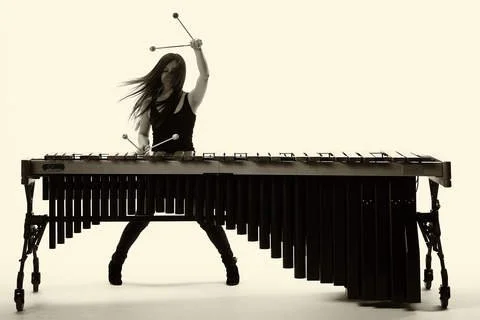
The concert I attended featured world-class percussionist Kato Kuniko, playing on a vibraphone and a marimba. The performance space was the museum’s largest exhibition room, currently featuring a small selection of works by Tawa Keizo. Mr Tawa was in attendance, and it was a pleasure to briefly meet one of the artists whose work I have been able to appreciate at MMAT. Tawa works with iron – he hammers the metal himself, often for days on end, to produce imposing, almost matte black works with visible impact marks on top where his hammer has struck. In this way the works display their very process of creation and invite the viewer to imagine the physical power required to produce them, and by extension other everyday works of metal. Uniquely for Tawa, the large pillars displayed currently at MMAT are so tall that his signature impact marks are invisible to the viewer; instead, having learnt of his usual technique through wall-mounted information, we must imagine the marks ourselves.
It's important to start with Tawa’s ironworks because, located directly in the centre of the room, they change the acoustics of the performance space. I can’t claim to know much at all about acoustics or sound, but even the disruptive image of the pillars standing between audience and performer suggested to me that perhaps the soundwaves from her instruments were being disrupted too, redirected or amplified. At points, after a powerful strike on the instruments, one could hear and feel a lingering, metallic ringing in the air, and I’m not sure whether that was produced by the vibraphone, the pillars, or both. Kato’s performance, her hammering away at her two large instruments, in showcasing a great deal of physical force, seemed to mimic the very creative process behind Tawa’s artworks. In this sense the museum and artworks are more than a venue and background for the performance but an integral part of it. In a different setting, some of its power would surely have been lost.
As for the music itself, I’m woefully underequipped to do it justice. I enjoy music, but I rarely listen to instrumental or classical music and the only performances I’ve ever attended that featured a single performer playing one kind of instrument are Taiko drumming shows. Nevertheless, I enjoyed this performance enough that I want to try seeing more like it. Our focus was directed squarely towards the single performer and her single instrument (the vibraphone and marimba were each the star of a dedicated part, so at any one time she was only playing the one instrument). In this way the sheer volume and effective power of each instrument and the physical exertion required to play it could be showcased. In wearing a sleeveless top, Kato made it very clear how much muscle one might gain from this kind of performance.
The performance alternated wildly. On the one hand were beautiful sections with an easily discernible rhythm, on the other, chaotic periods where Kato seemed to smash keys at random. In these sections, she often looked like she was toying with the instrument, experimenting to see what sound she could produce and how. She would strike once, and then turn her ear to the instrument as if studying the resultant sound. In this way it reminded me a little bit of a genre I enjoy that I never would have guessed I would think of during this kind of performance – Noise. Noise artists, too, experiment in real time with their equipment, pushing buttons and switching between blunt objects to see what they can create, only their instruments are electronic, and their performances often end in total destruction. In contrast, Kato seemed to be trying to create something out of her random strikes – when the sound became more rhythmic, it was like she had hit on an idea and turned it into a melody right before our eyes.
At times, the performance was relaxing. Kato would tap her mallet to the metal or wood so gently that it didn’t even appear to make contact. The faintest response would reverberate around the room, so quiet as to be more physical sensation than sound. She might glide the mallets back and forth along the instruments to produce a scaling rhythm. Here and there she would grasp two mallets in one hand between her finger, allowing her to hit double the notes at once and produce an even quicker scaling effect or a more constant drone of sound, by doing nothing more than rotate the wrist slightly back and forth.
Or, she would lift her arm high, sometimes taking a short breath before letting the mallet slam down onto the instrument, much like a hammer. These more forceful moments, in which the vibraphone and marimba produced their loudest sounds, seemed to send Kato into something of a frenzy, her body darting back and forth, arms flailing and head swaying, as if possessed by the sound. Where quieter sections struck me as rather beautiful, these more chaotic ones were, if anything, a little scary. I certainly never thought I’d say that about a marimba. By alternating quickly between states of frantic, forceful smashing and more peaceful intervals, Kato never once let the performance become stale, or repetitive.
Of course, the use of two different instruments is also important. With the vibraphone Kato seemed to focus more on individual notes, which would continue to ring for many seconds in the spacious exhibition room. With the marimba, its wood producing shorter sounds, she more commonly would strike multiple notes in succession. But generally, I think her approach to the two instruments differed little. It seems to me that Kato, in the spirit of experimentation with sound referenced above, was determined to elicit similar sounds from both instruments in spite or their very different design and materials.
All in all, I may not be able to give the same level of review as an expert on music, but I can certainly attest to the effect the performance had in making me question my own preconceptions of what kinds of music and what kinds of instruments I enjoy, and also in making me rethink the very boundaries of what a museum can be. I don’t think it’s an exaggeration to say that, in the space of the Meguro Museum of Art’s very own exhibition room and aided by the exhibition itself, I had watched a piece of collaborative art be created in real time. I would encourage anyone interested in music or art to keep an eye out for the next one.